These images have been selected from those recorded at Mt. Kent Observatory in Queensland, Australia, Mt. Lemmon Observatory in Arizona, USA, and Moore Observatory, in Kentucky, USA.
This material
is
Copyright 2025
John Kielkopf, University of Louisville, unless otherwise noted.
It is licensed with a Creative Commons
License, which provides that
it may be used freely for non-commercial purposes
provided that the license terms are
made clear to others, and that the source and Copyright are acknowledged.
Original resolution files are available on request.
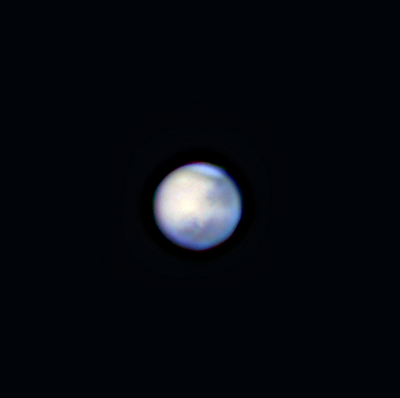
Mars on the morning of 2025-01-18 UTC, a day after opposition. The image is a color composite of three taken sequentially in the Sloan i', r', and g' bands. with an ASI 6200 CMOS camera and 0.02 second exposures through our 0.6 meter Ritchie Chretien telescope at Mt. Lemmon. The color rendering maps i' to red, r' to green, and g' to blue and yields an approximation of visual colors shifted toward the near infrared. The color balance is adjusted for equal weighting of each band. This image has been post-processed with unsharp masking to enhance contrast and reduce the effects of Earth's atmospheric turbulence.
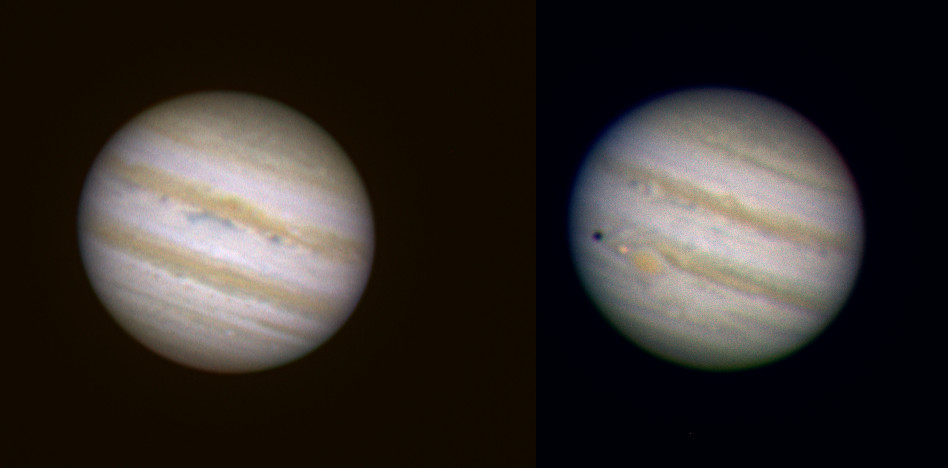
Jupiter on two nights, 2023-11-08 and 2023-11-12 UTC, nearly at opposition and showing opposite sides of the planet with the Manner 0.6 meter telescope on Mt. Lemmon. The images are false color composites of Sloan i' (red), r' (green), and g' (blue) exposures emphasizing the near infrared. The resolution is seeing limited, with contrast slightly unsharp masked to make fine detail more apparent. The image on the right reveals the Great Red Spot, the disk of Io, and its shadow.
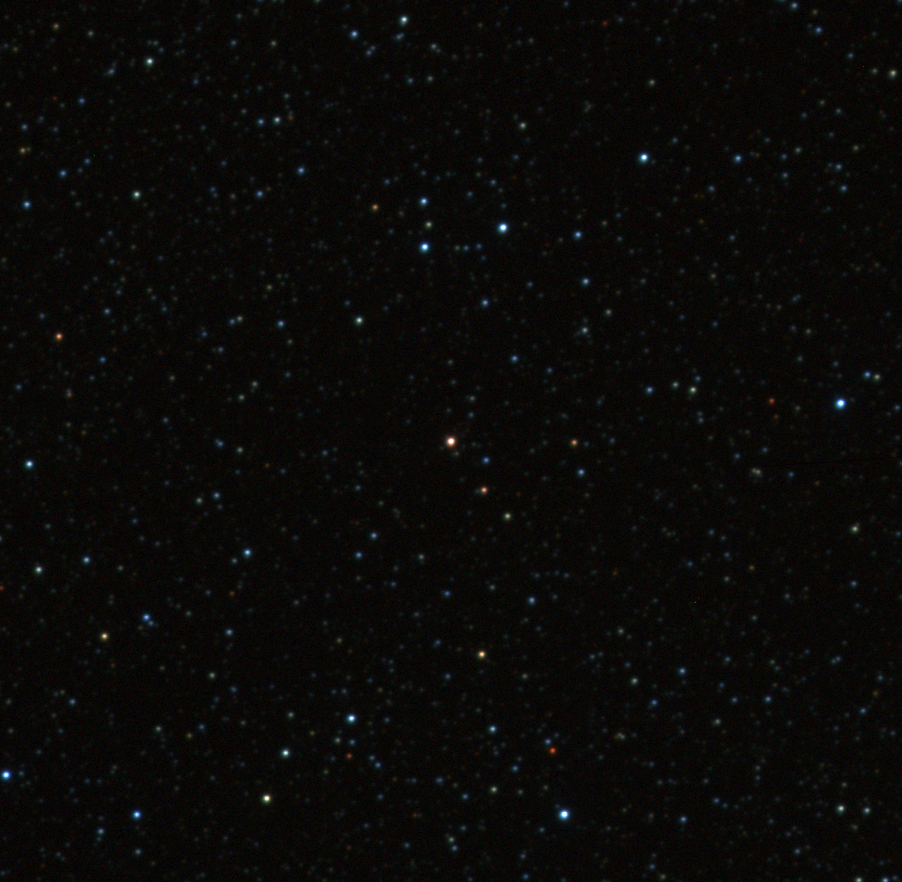
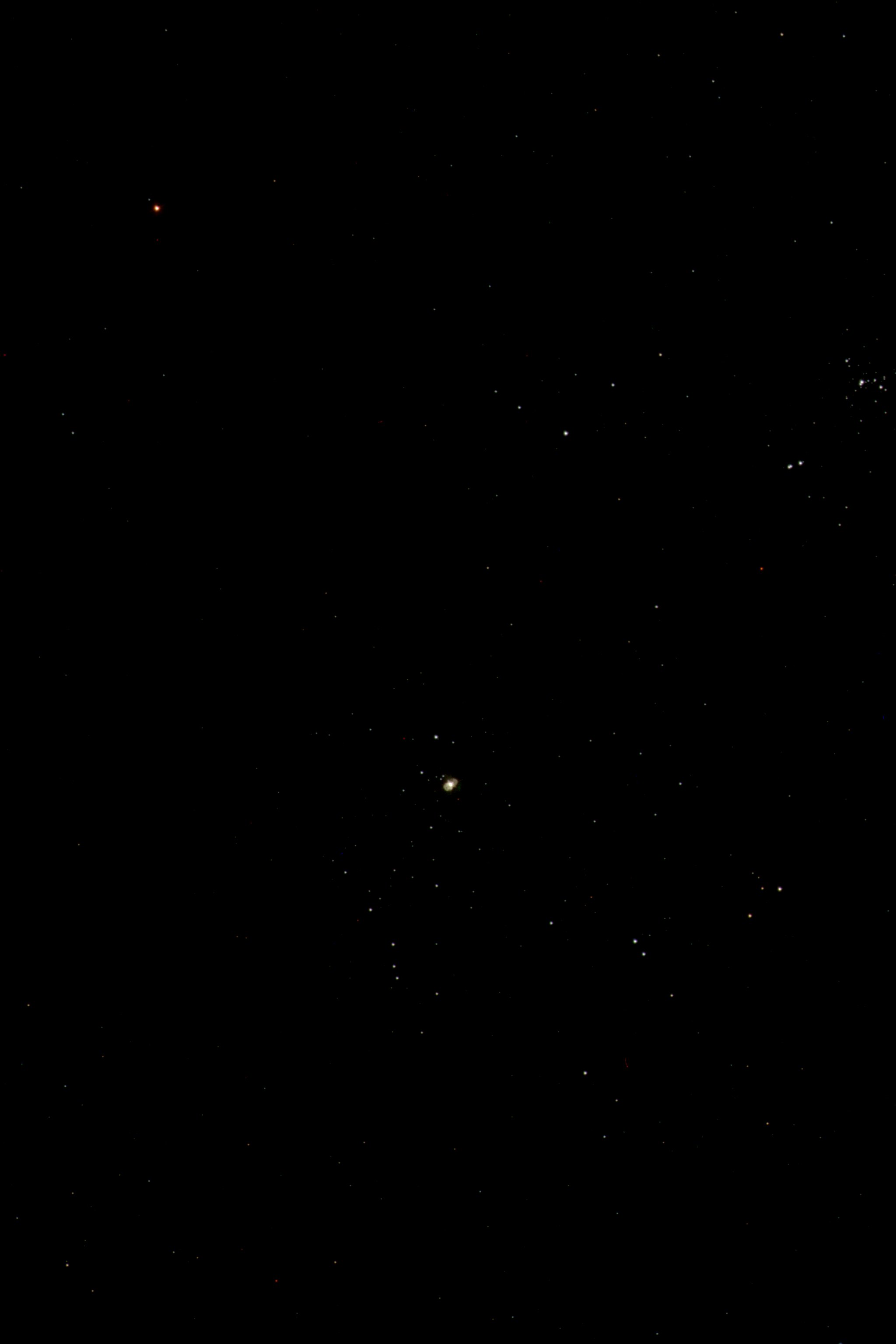
Proxima Centauri, the nearest known star to our solar system and host to one or more planets, is shown here in an image taken on April 23, 2020, at Mt. Kent observatory. This is a composite of 3 exposures through Sloan i' (infrared), r' (red), and g' (blue-green) photometric filters. The image was rendered in SAOImage ds9 with red, green and blue corresponding to those three filter bands and processing to enhance the faintest stars. The field of view is oriented with north up and west to the right. Proxima is the 11.05 V magnitude spectral type M5.5V red star at the center.
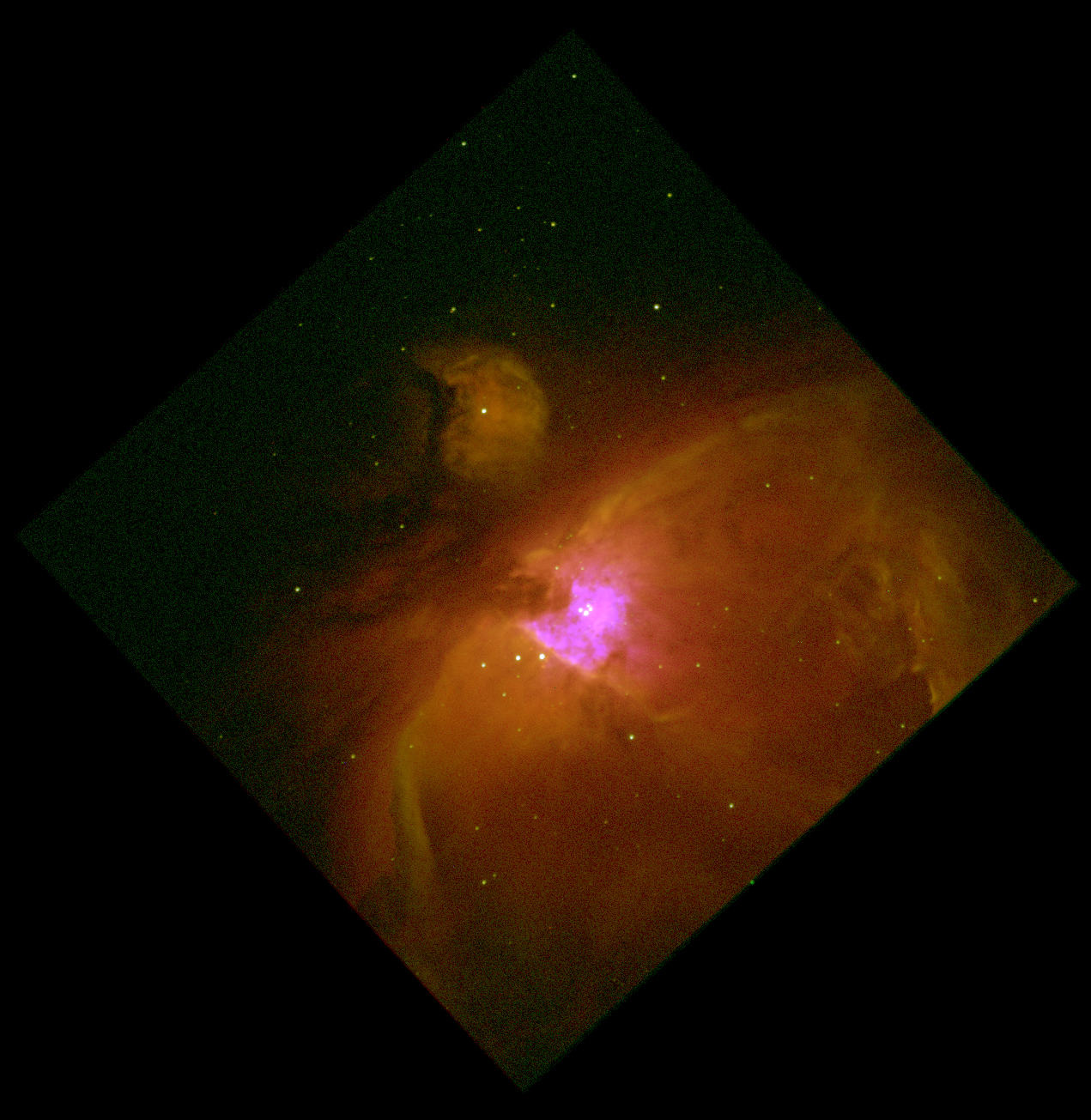
The Orion Nebula (Messier 42) from the CDK700 at Mt. Kent, November, 22, 2019. The composite color image has hydrogen alpha in red, ionized sulfur in green, and ionized oxygen in blue with a total exposure time of 30 minutes.
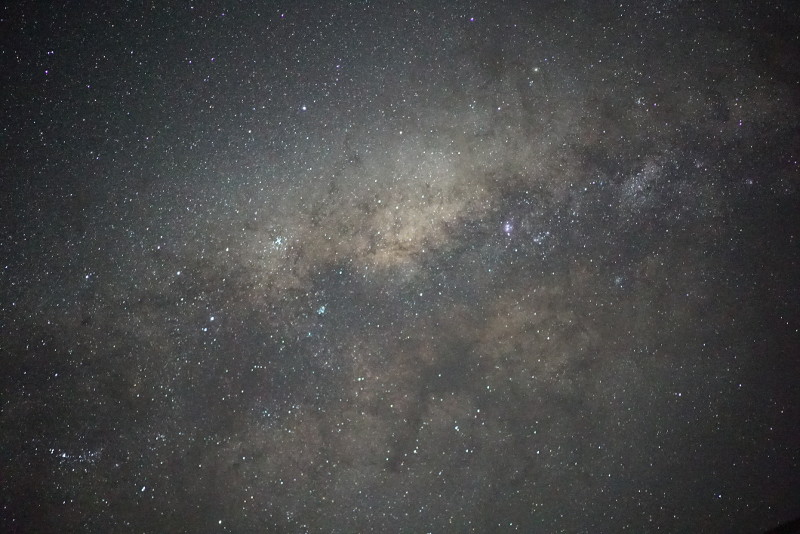
The Milky Way over Mt. Kent on October 10, 2015.
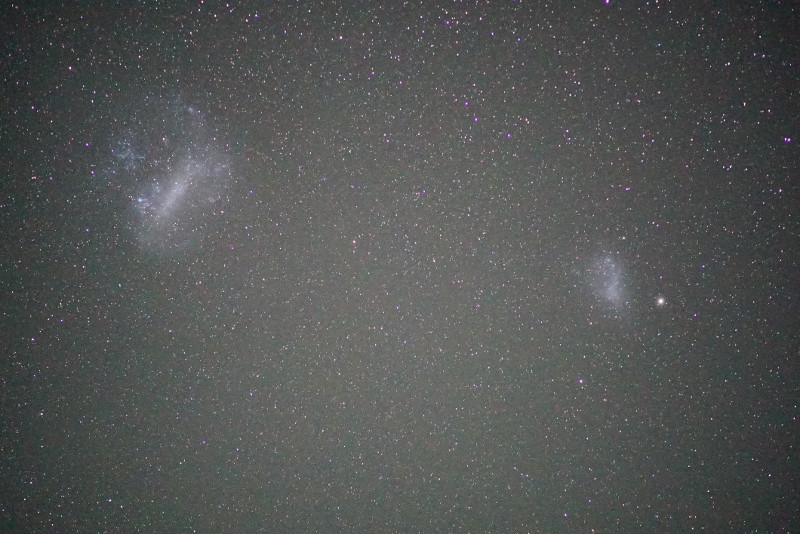
The Small and Large Magellanic clouds appear to the unaided as they do in this wide field image recorded with a low-light sensitive Sony Alpha-7s camera on October 9, 2015.
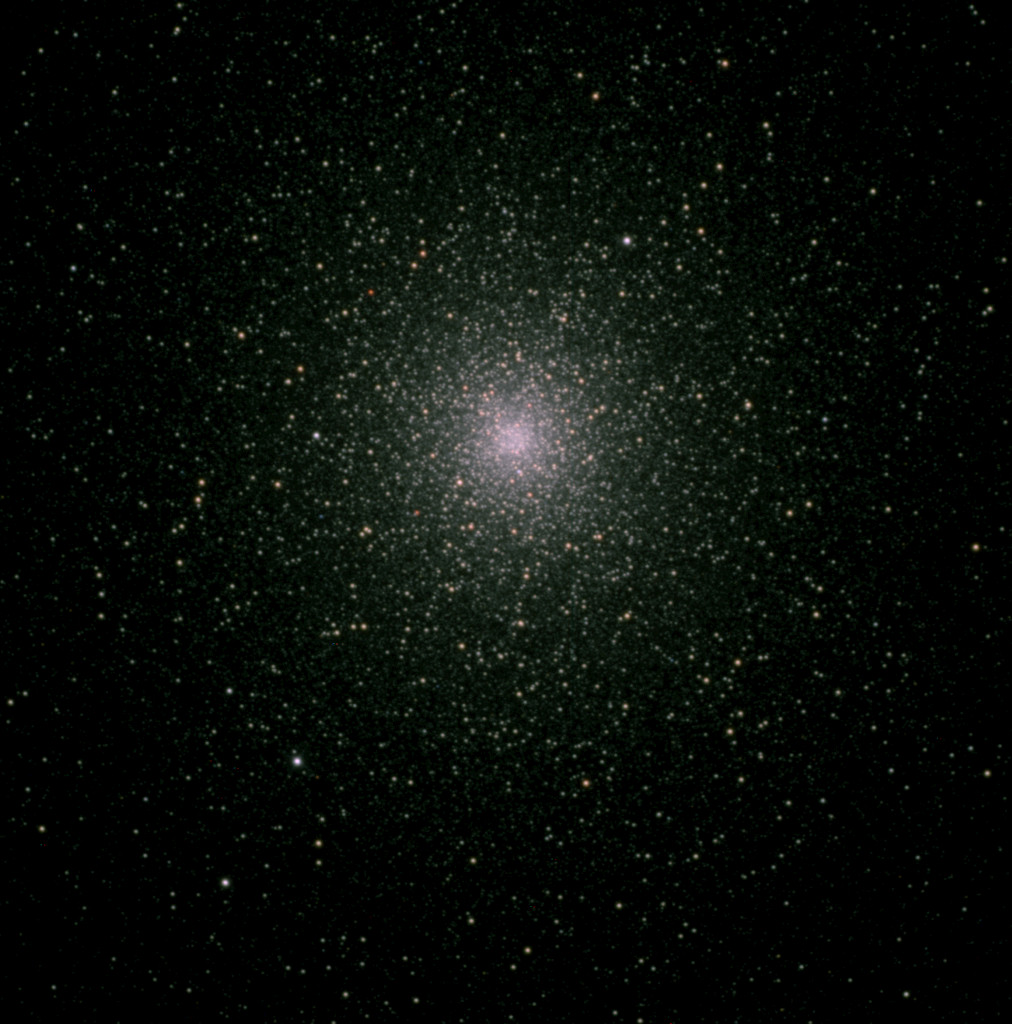
NGC 104, the globular star cluster 47 Tucanae, recorded on the night of October 12, 2015, at Mt. Kent Observatory with its CDK700 telescope. The color image is a composite of 3 frames exposed for 100 seconds through the Sloan i', r', and g' filters. Red in this image is actually near infrared through the i' filter, green is from the r' filter, and blue is from the g' filter. Stars which appear redder are cooler. The original data are displayed here on a logarithmic scale to render both bright and faint stars for the screen. This is the full 25 arcminute field of view of the CDK700 with its Apogee U16 camera. North is to the upper right.
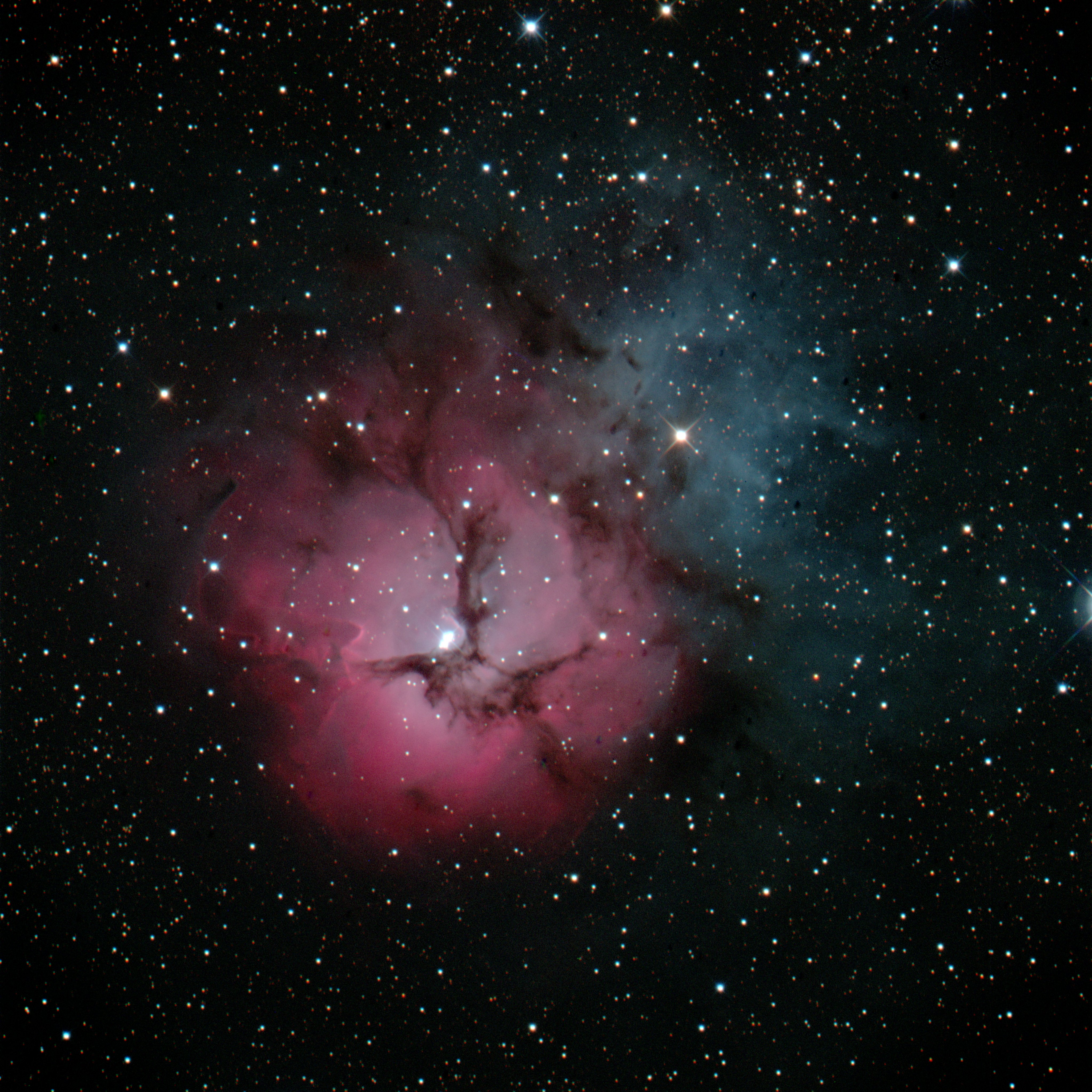
The Trifid Nebula, Messier 20, recorded on the night of August 27, 2013, at Mt. Kent Observatory with its CDK700 telescope by Richard Hedrick. This is the "first light" image with the telescope. It is a composite of 3 frames through red (R), green (G), and blue (B) filters, each a 120 second exposure. The images were dark corrected and log stretched with Alsvid software, and then aligned and rendered in AstroImageJ to produce this composite color view.
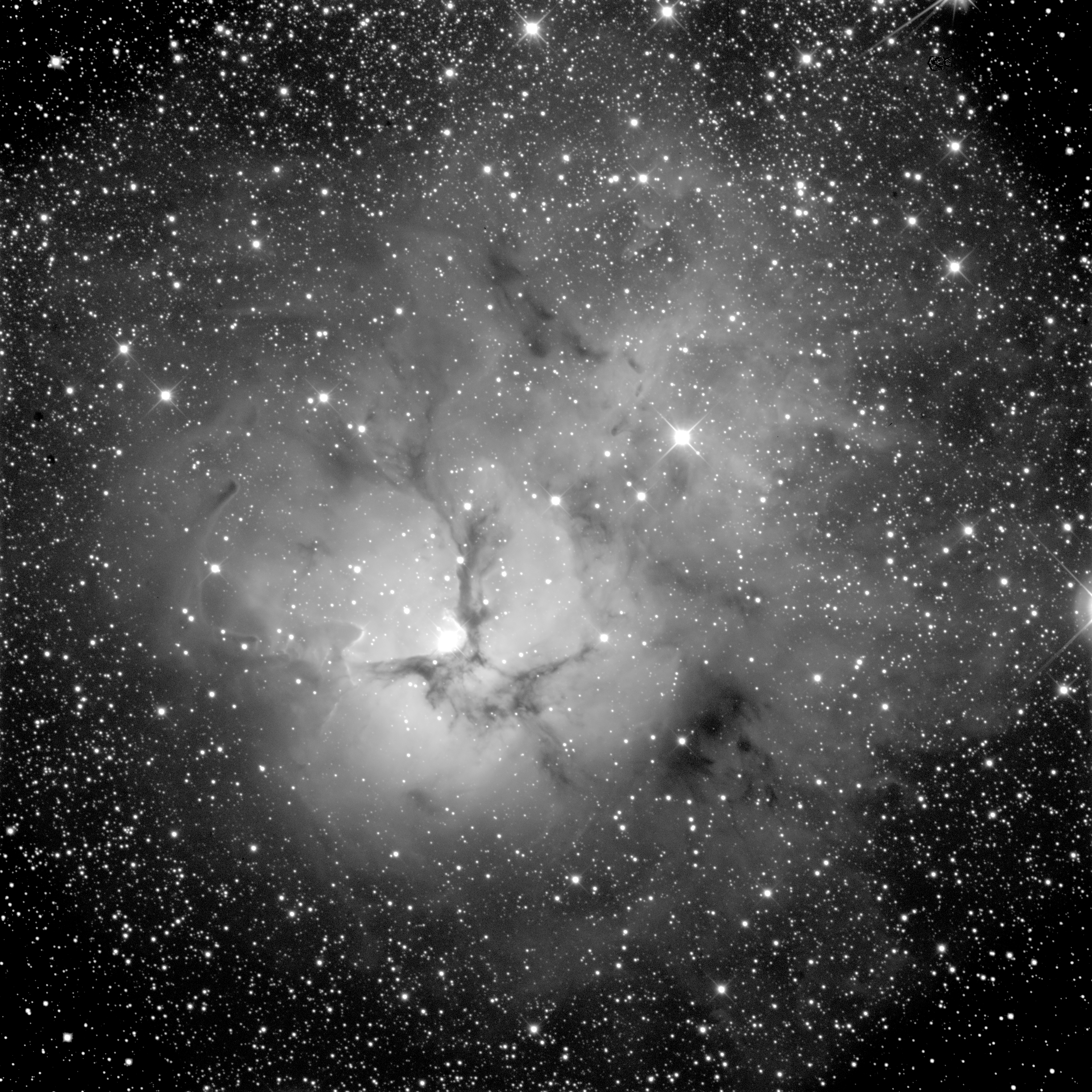
Another view of the Trifid Nebula, Messier 20, also recorded on the night of August 27, 2013, at Mt. Kent Observatory with its CDK700 telescope by Richard Hedrick. This "first light" image is a sum of three 120 second unfiltered exposures, and it captures all the light the CCD camera can sense, from the near ultraviolet through the near infrared. The images were dark corrected, combined in AstroImageJ, and then log stretched with Alsvid software.
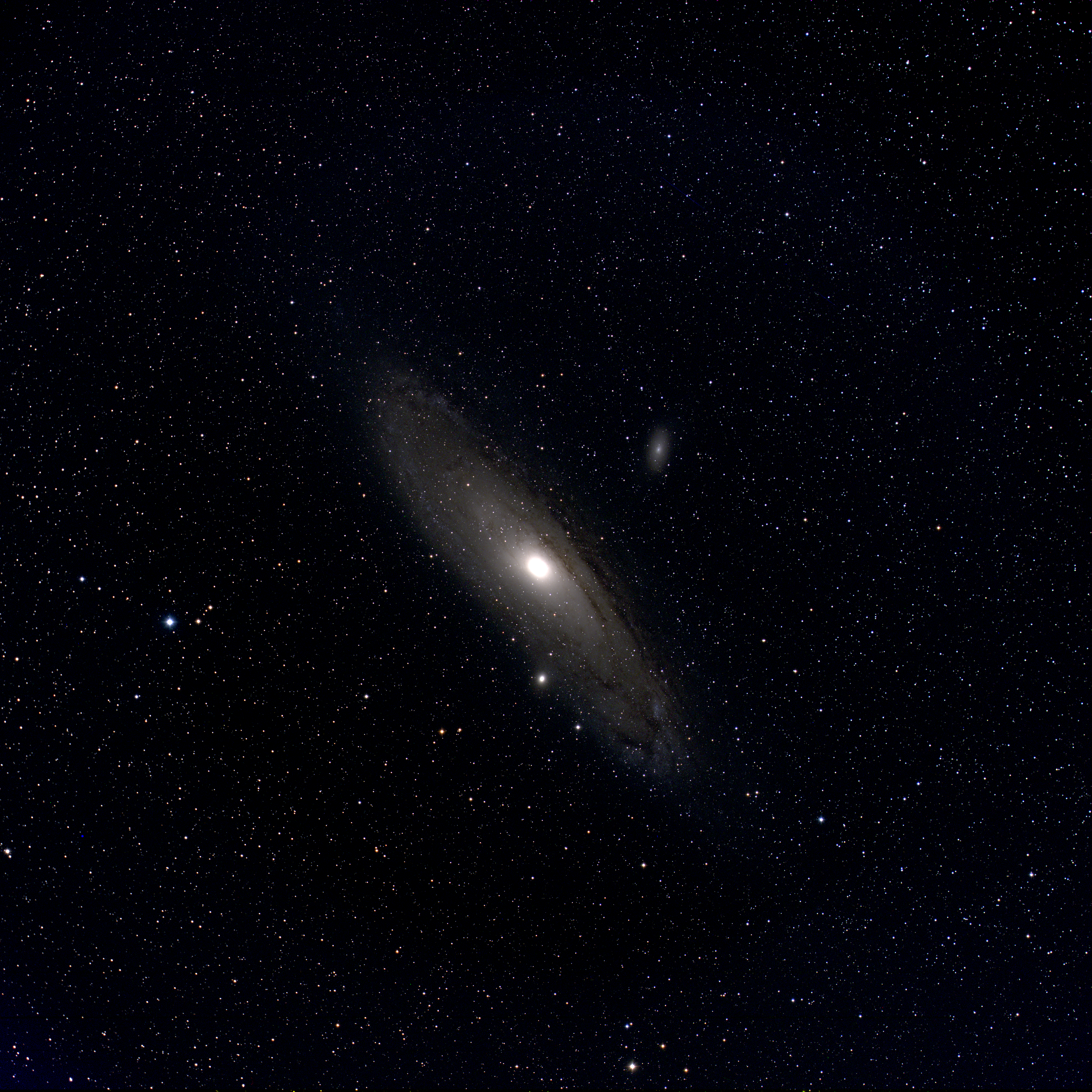
The Andromeda Galaxy, Messier 31, and its companions M32 and M110, was recorded with the wide field Takahashi FSQ106-ED telescope at Moore Observatory on November 22, 2012. This image is a sum of 16 100-second exposures in the Johnson-Cousins B, V, and R filter bands. The color image is an approximately visual true-color representation balanced so that type A stars appear white. The intensity scale is square-root compressed to show a larger dynamic range than the eye could see naturally. The full image has a field of view of about 4 degrees. Click the image to see it in more detail.
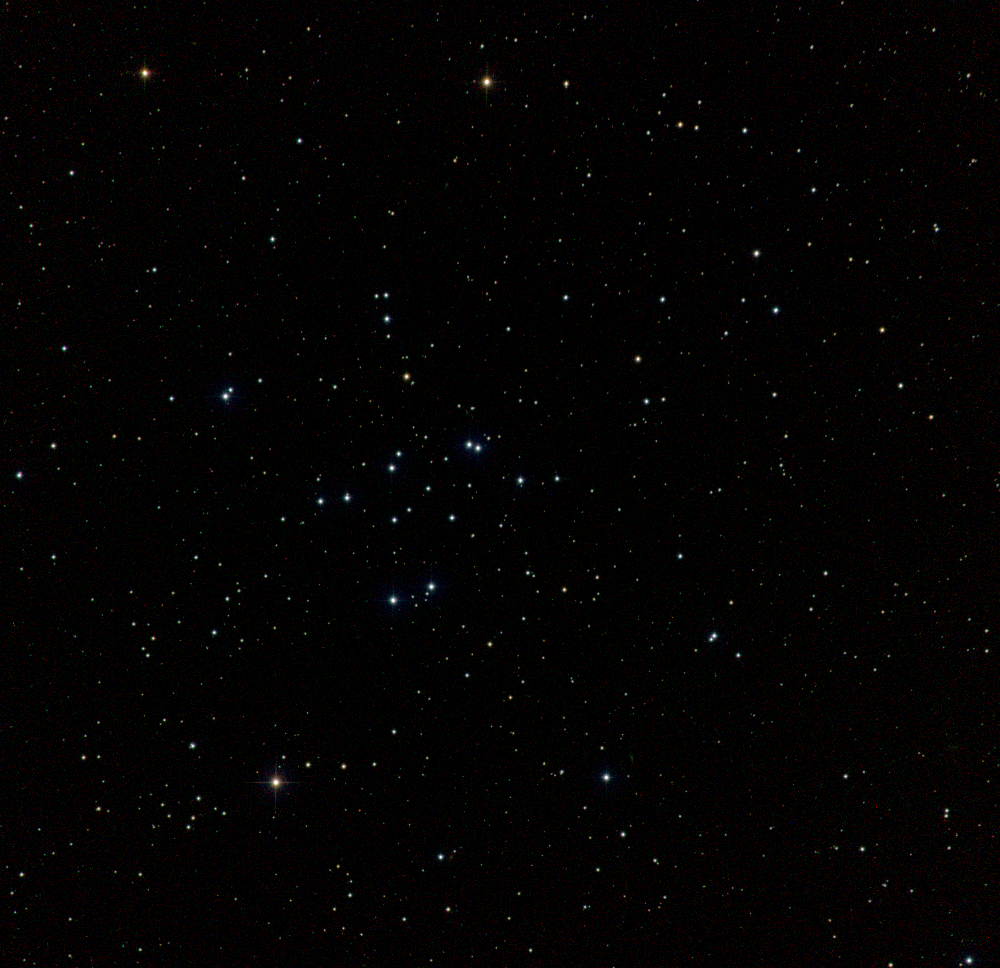
Messier 34 on the night of UT 2012-11-05 taken with the CDK20N telescope. This is a false color image with the infrared Sloan z' filter mapped to red, the red Sloan r' filter displayed as green, and the blue-green Sloan g' filter displayed as blue. This enhances the color differences and makes the temperature differences of the stars in this cluster more distinct. The field is about 0.5 degree, the apparent size of the full Moon.
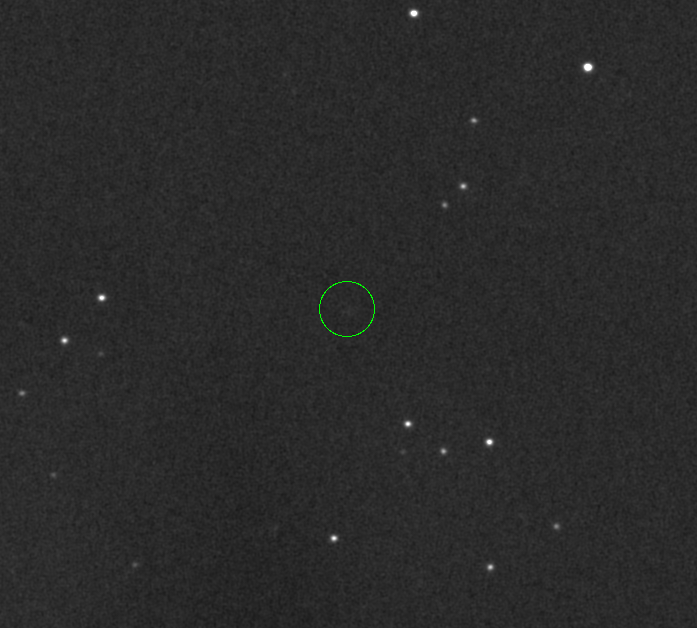
Comet C/2012 S1 (ISON) on UT 2012-10-02 at 6:43. This total exposure of 1300 seconds was taken with the CDK20N telescope through a blue-block filter. Comet ISON, indicated here inside the 15 arcsecond diameter circle, is approximately 18th magnitude. This image was taken on the night of full Moon, and the bright background has been subtracted. The comet's surface brightness is only slightly greater than the sky.
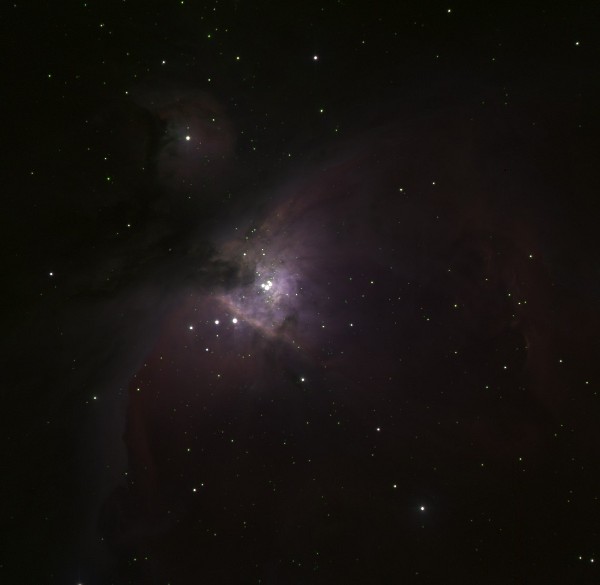
The Orion Nebula, Messuer 42, recorded with the CDK20N telescope on the night of November 1, 2011. This is a composite of three 100-second photometric images in the Sloan g' (shown as blue), r' (shown as red), and i' (shown as green) bands. The intensites are displayed with logarithmic compression. Click to see the inner regions with square root compression. Highly reddened stars are brighter in the infrared (i') and appear slightly green in these images.
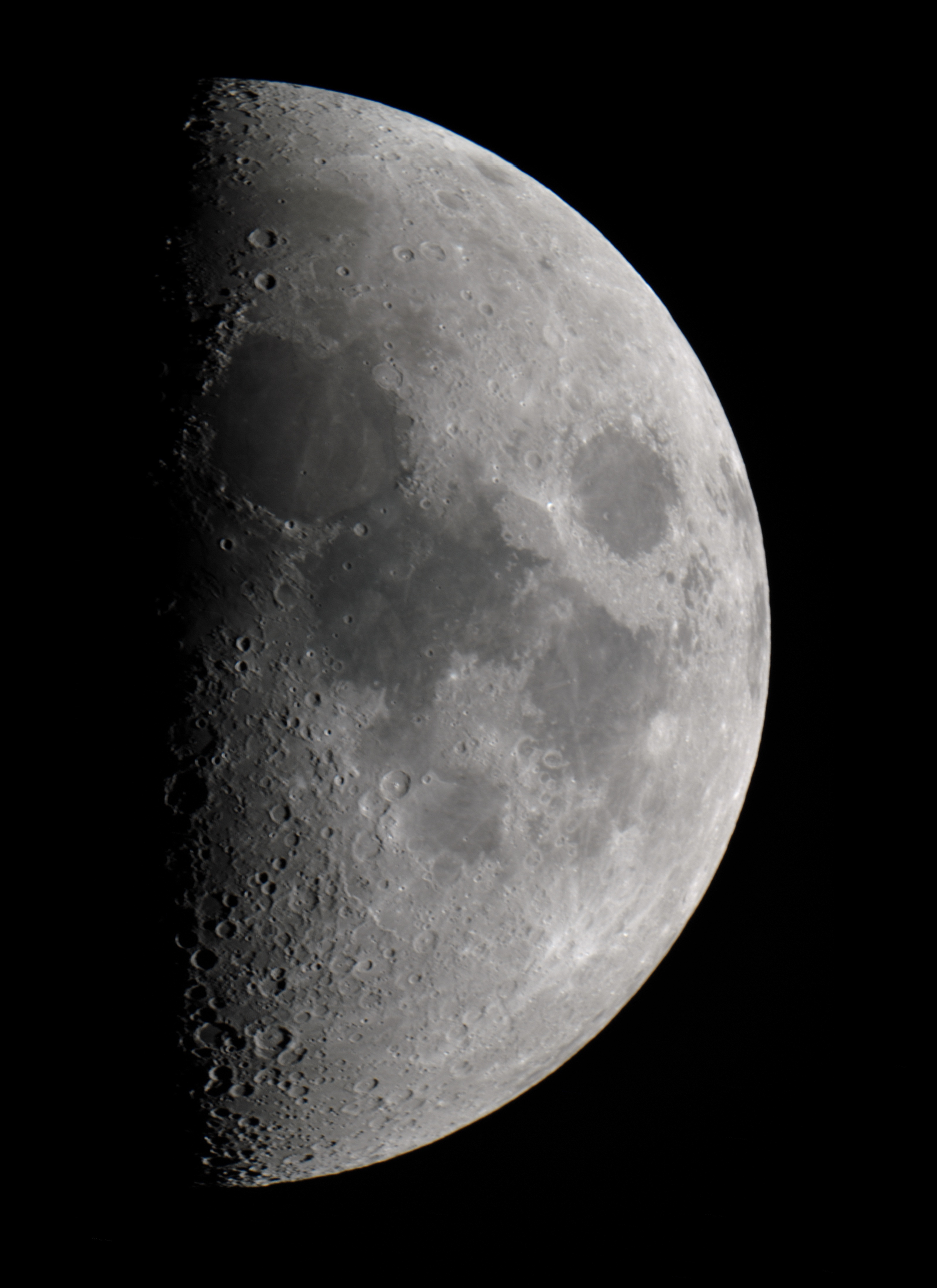
The first quarter moon on August 17, 2010 at 02:20 UT was recorded through thin cirrus with the CDK125 Shared Skies Live telescope at Moore Observatory. This montage was made from 2 1/200th second exposures at ISO 320, each a sum of 20 aligned images taken 5 seconds apart with a Nikon D200 camera, and processed with unsharp masking to enhance detail. At this time of year the first quarter moon is low in sky for sites in the northern hemisphere and the image is not as sharp as the last quarter moon seen below. Click on the image for the full resolution version.
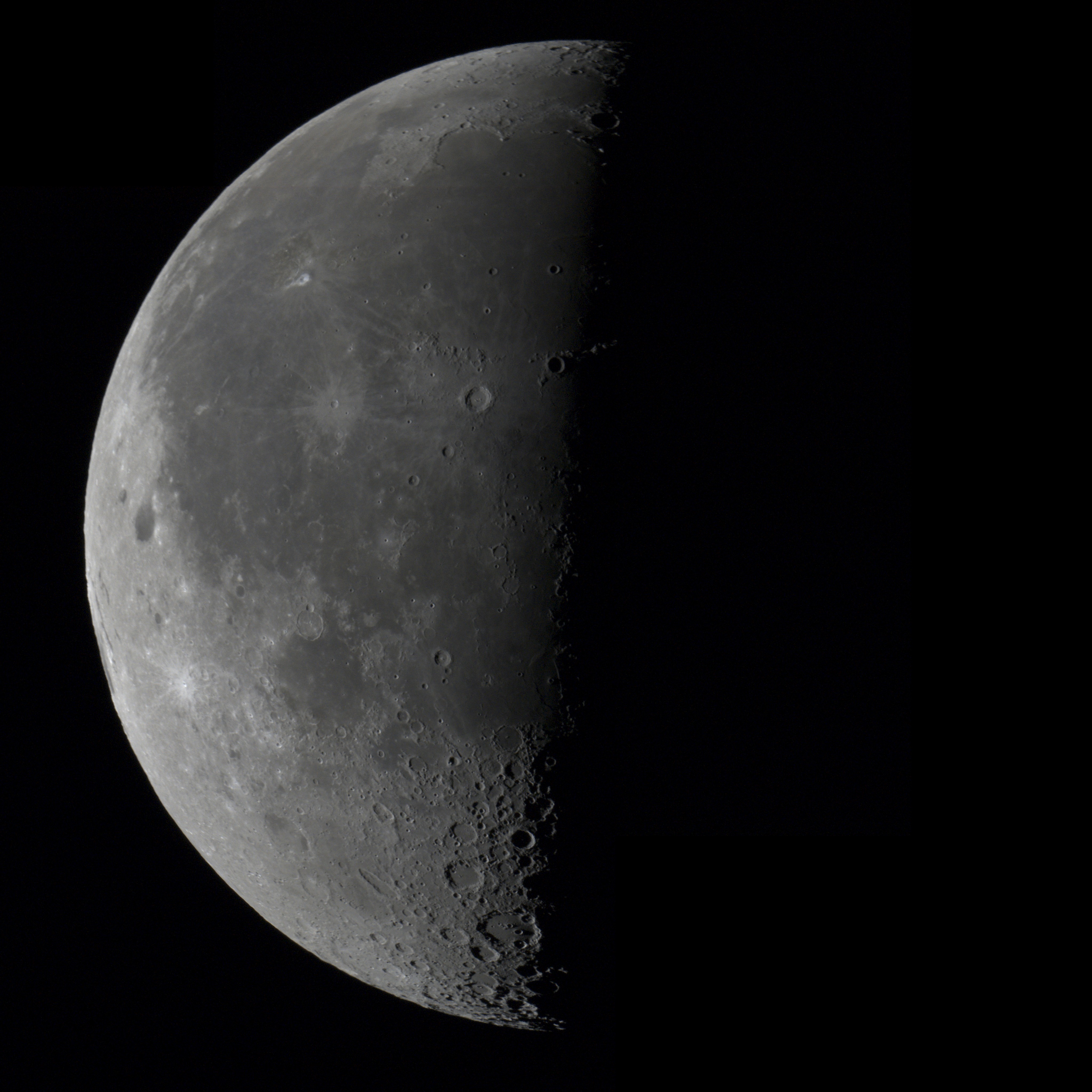
The last quarter moon on August 3, 2010 at 07:21 UT was recorded with the CDK125 Shared Skies Live telescope at Moore Observatory. This montage of 3 1/200th second exposures at ISO 400 with a Nikon D200 camera has been processed with unsharp masking to enhance detail. Notice the fine structure inside Copernicus, the rayed crater above center near the terminator in this image, and compare the view for the nearly full moon taken a week earlier shown below. Click on the image for a more detailed view.
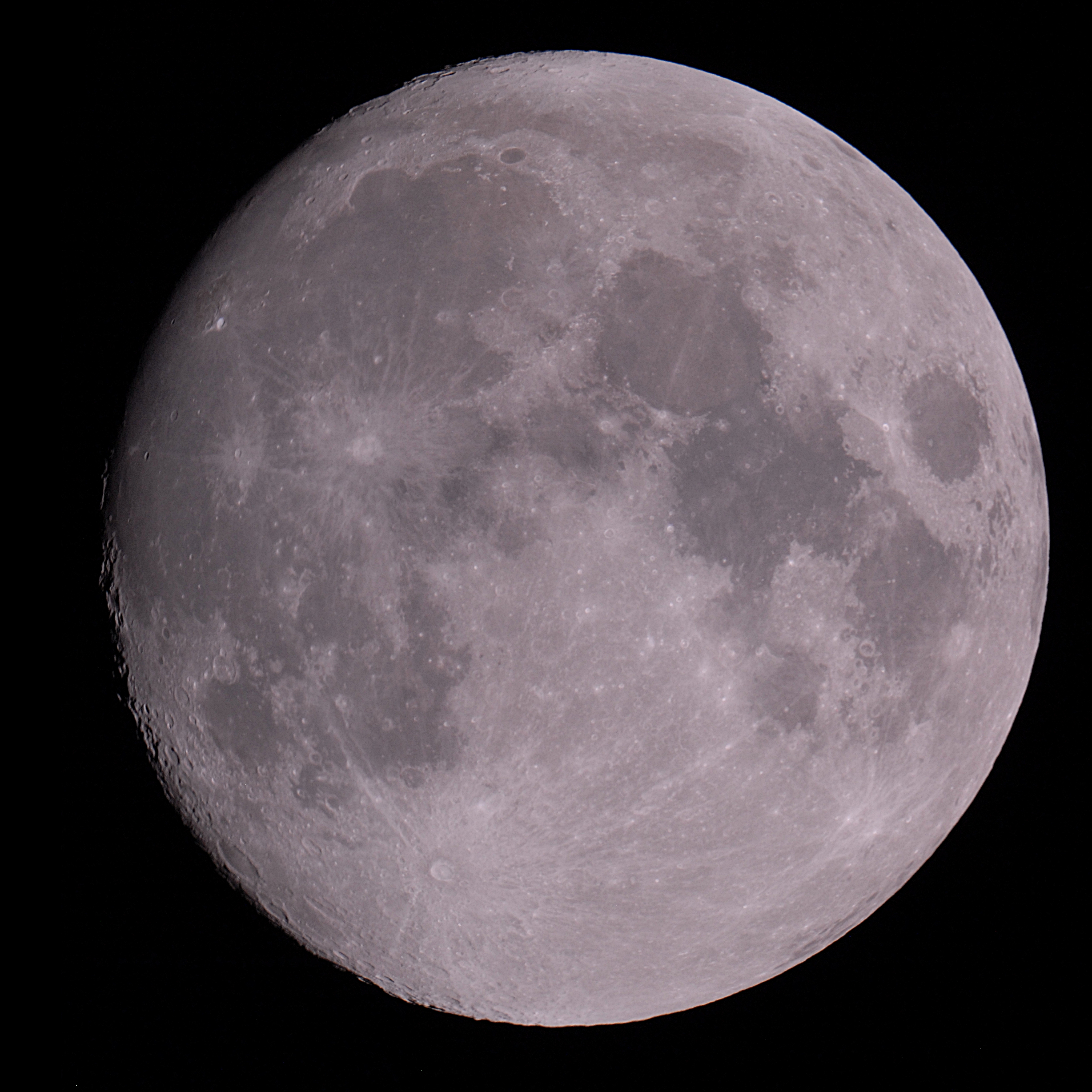
The gibbous moon on July 24, 2010 at 04:57 UT was recorded with the CDK125 Shared Skies Live telescope at Moore Observatory. This montage of 4 1/400th second exposures with a Nikon D200 camera has been processed with unsharp masking to enhance subtle features so that the image is what you would see looking through the telescope. Tycho is the bright rayed crater near the lower limb. Compare to the image above, taken a week later, when Tycho was on the terminator. Click on the image for a more detailed view.
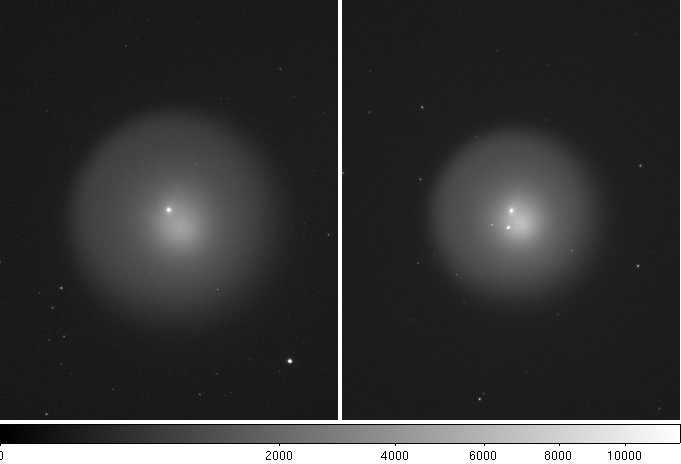
Comet 17P/Holmes on the nights (UT) of (right) October 29 and (left) 30, 2007, in images taken with the Louisville CDK20. North is up and west to the right. Each frame is 3 minutes of arc wide. The two exposures are separated in time by approximately 24 hours. Notice that the coma in the second image is larger than in the first, with an expansion rate of approximately 23 seconds of arc per day. Extrapolated backward, the event which gave rise to the sudden brightening of Comet Holmes would have occurred around October 24 when it was first noticed.
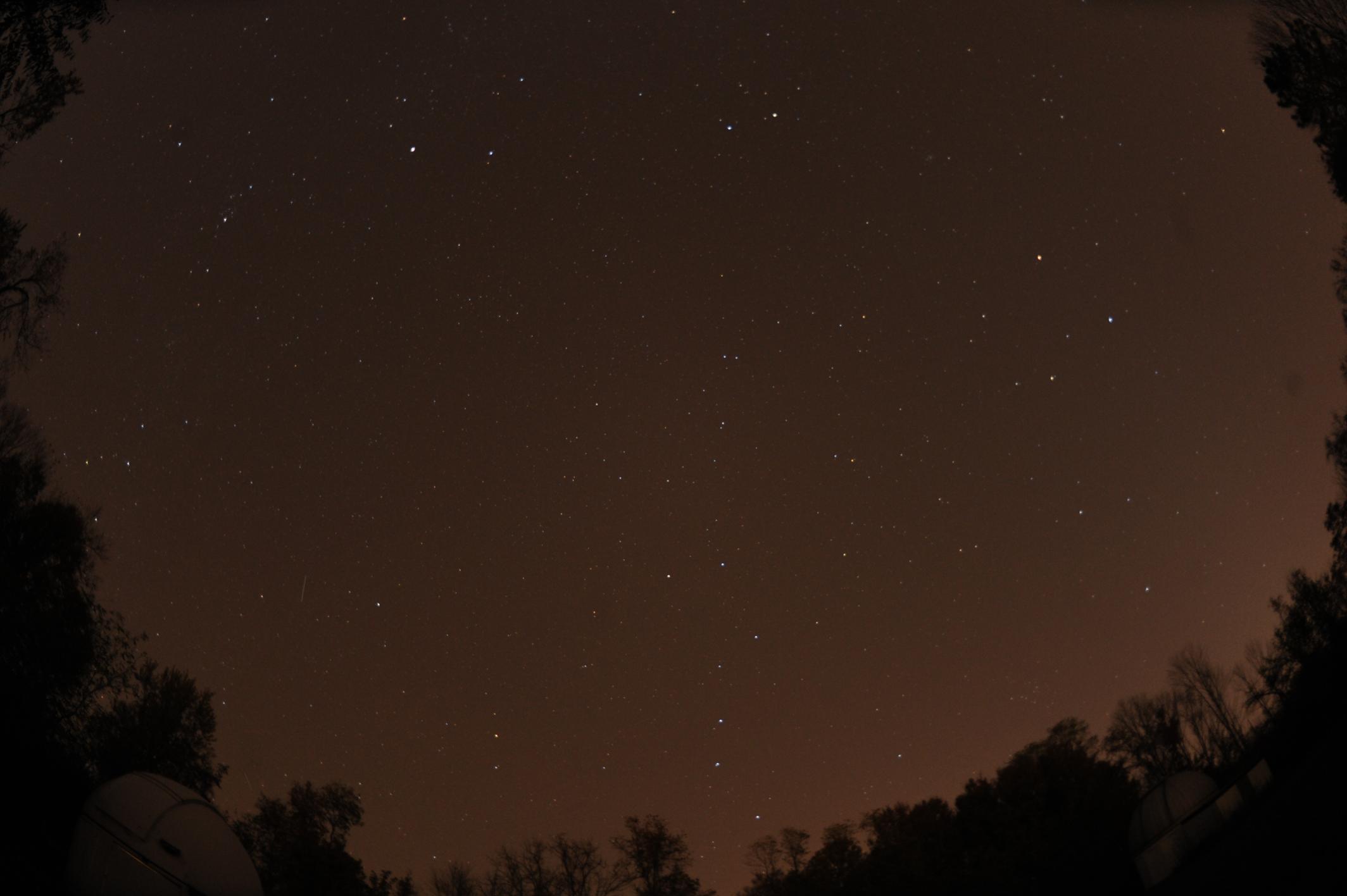
Dawn at Moore Observatory at 6:30 AM (10:30 UTC) on the morning of October 25, 2011. The image is a 10 second exposure at ISO 1600 with a Nikon D300s camera and an 16~mm focal length f/2.8 fisheye Nikor lens. Polaris is over the CDK20 dome on the left and Ursa Major is rising in the center. Leo with Mars is in the east on the right.
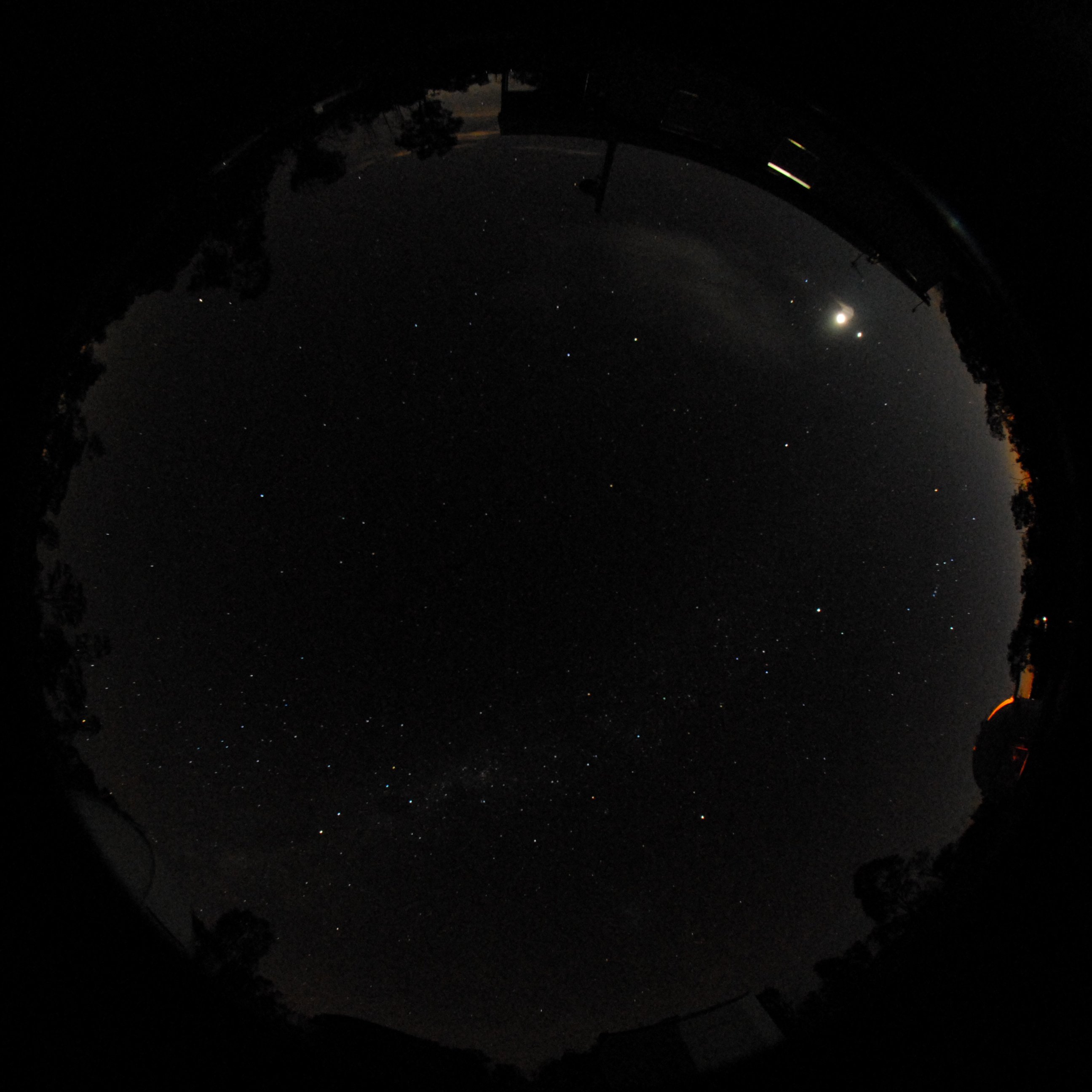
The Milky Way, first quarter Moon, and Venus at Mt. Kent on the night of May 21, 2007. This is a 30 second exposure with a Nikon D200 and a f/5.2 Coastal Optical Systems 4.88 mm focal length fisheye lens. Click the image for the full resolution version to see Alpha and Beta Centauri and the Southern Cross on the lower left in the south, Canis Major following Orion setting in the west on the right, Venus near the Moon in Gemini toward the northwest, and Saturn in Leo north of zenith.
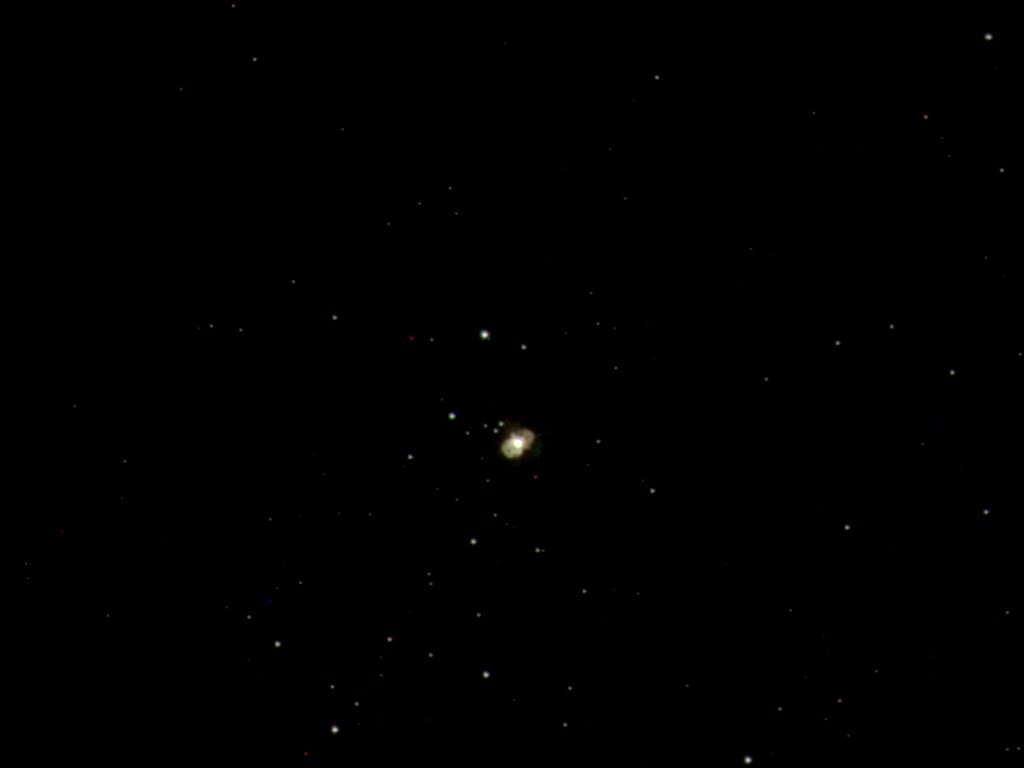
Eta Carinae from a set of 1-second exposures on May 20, 2007 at Mt. Kent with the CDK20, an STL6303 CCD camera, and the I, R, and V-band photometric filters. The bands are displayed in this image as red, green and blue, respectively. Color layers were extracted with a gamma of 2.0 from the original 16-bit dark-subtracted images. The combined color image as shown here was subsequently processed with an unsharp mask to highlight detail in the nebula surrounding the star, with weaker signals non-linearly increased to show fainter features. This image shows 1024x768 pixels covering a field of 9.2'x6.9' from the center of the image. A full resolution 2048x3072 (0.306x0.459 degree) version is available here. Compare this image with the high resolution image from the Hubble Space Telescope.
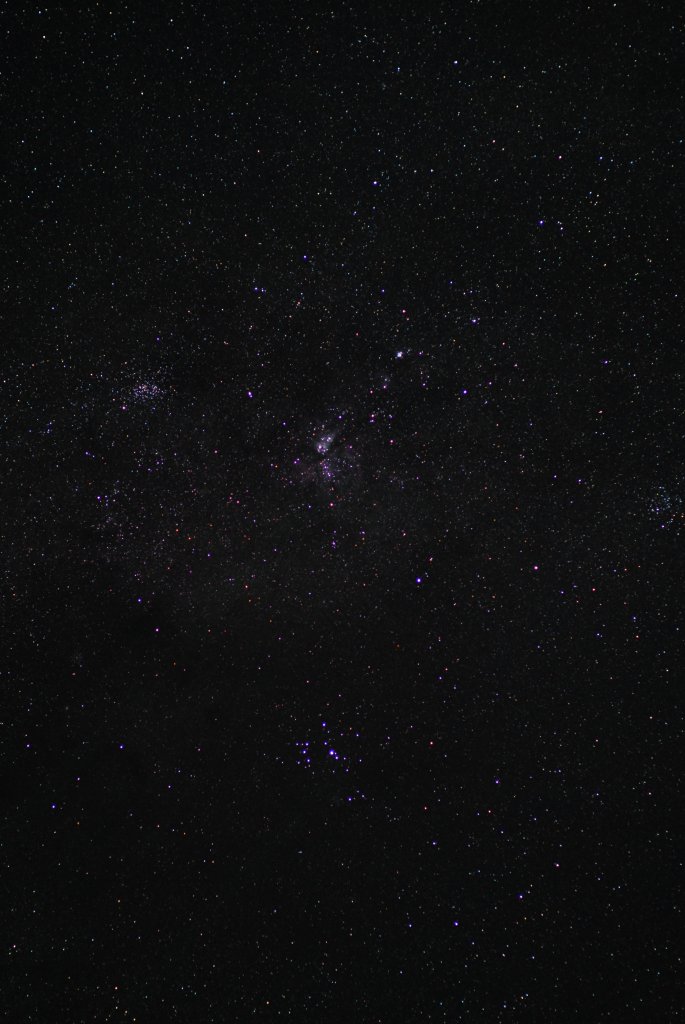
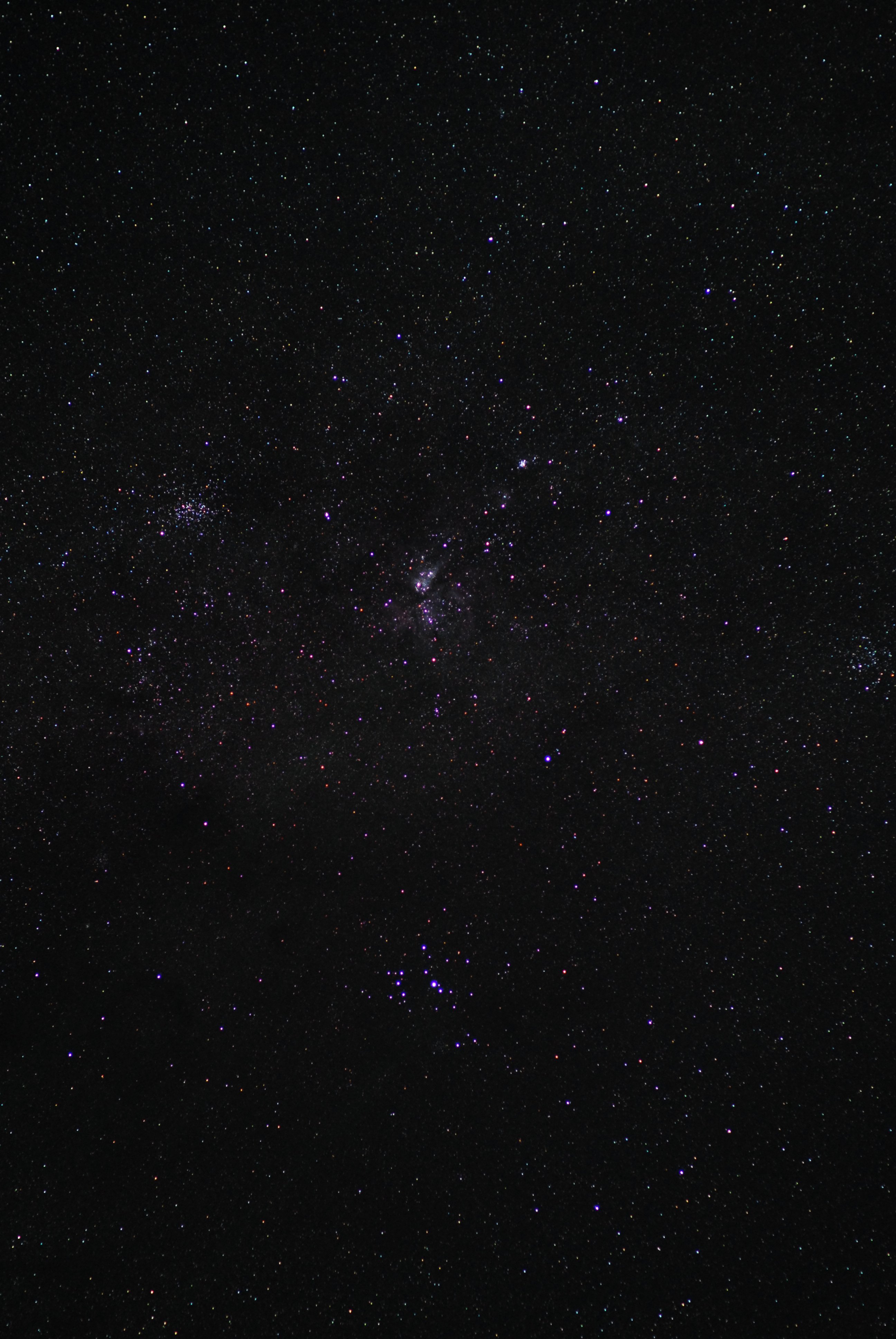
Carina and the Milky Way as recorded at Mt. Kent on May 23, 2007, in a 30 second exposure with a Nikon D200 and an 85 mm focal length f/1.4 Nikor lens used at f/2.0. The camera is mounted on the CDK20 to provide color images with a field of about 11x16 degrees revealing stars down to 11th magnitude. The image is centered on the supergiant star Eta Carinae. The full resolution version is available here. North is at the top and west at the right in these images, the same orientation as in the detailed image of Eta Carinae above from the CDK20. The large open cluster NGC 3532 is east of eta Carina left of center, and the smaller cluster NGC 3114 is on the western edge of the image slightly below center.
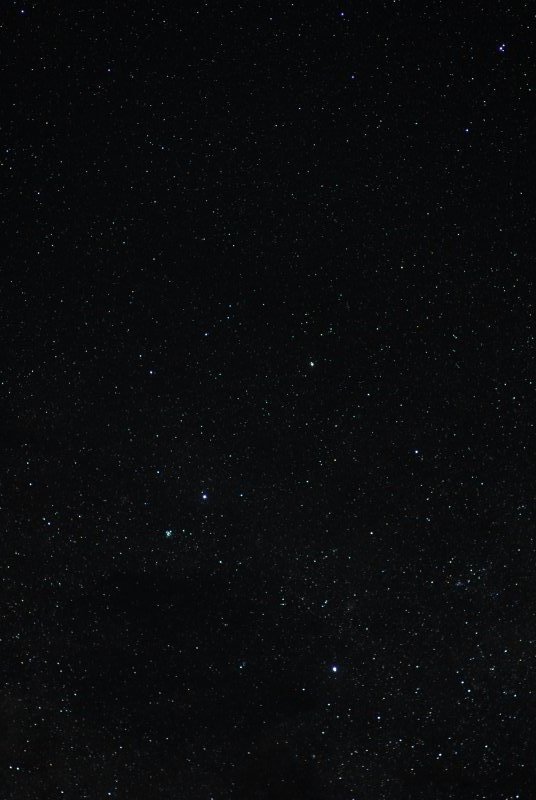
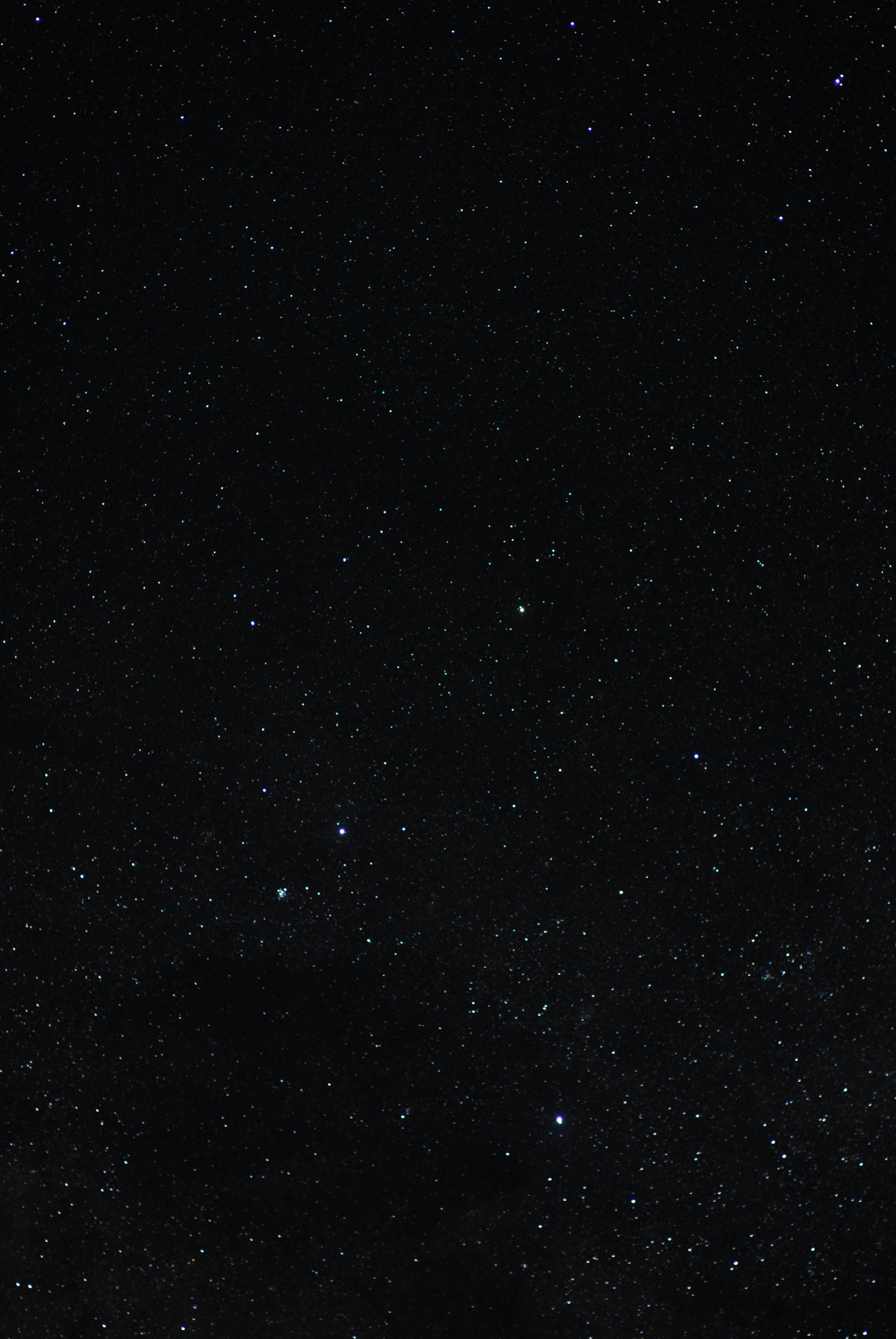
The Southern Cross (Crux) and the Coalsack Dark Nebula as recorded at Mt. Kent on May 23, 2007, in a 30 second exposure with a Nikon D200 and an 85 mm focal length f/1.4 Nikor lens used at f/2.0. The field is about 16x11 degrees. A full resolution version is available here. The images are centered on Gacrux, but the brightest star is Alpha at the bottom of the cross. The principle stars are Alpha (Acrux), Beta, Gamma (Gacrux) and Delta counterclockwise from the bottom. There is a naked eye fifth star, Epsilon, between Delta and Alpha. The five star pattern is featured on the Australian flag. A compact cluster NGC 4852 is slightly southeast of Beta. The Coalsack is the dark cloud largely devoid of distant stars southeast of the cross in the lower left of the image.
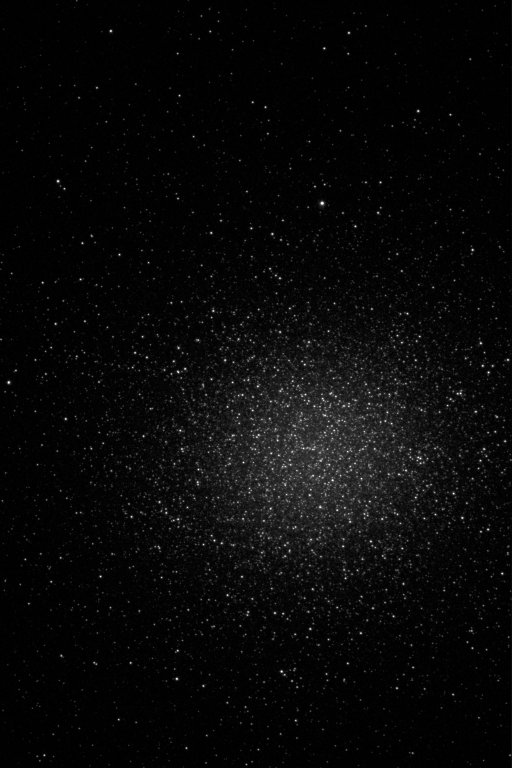
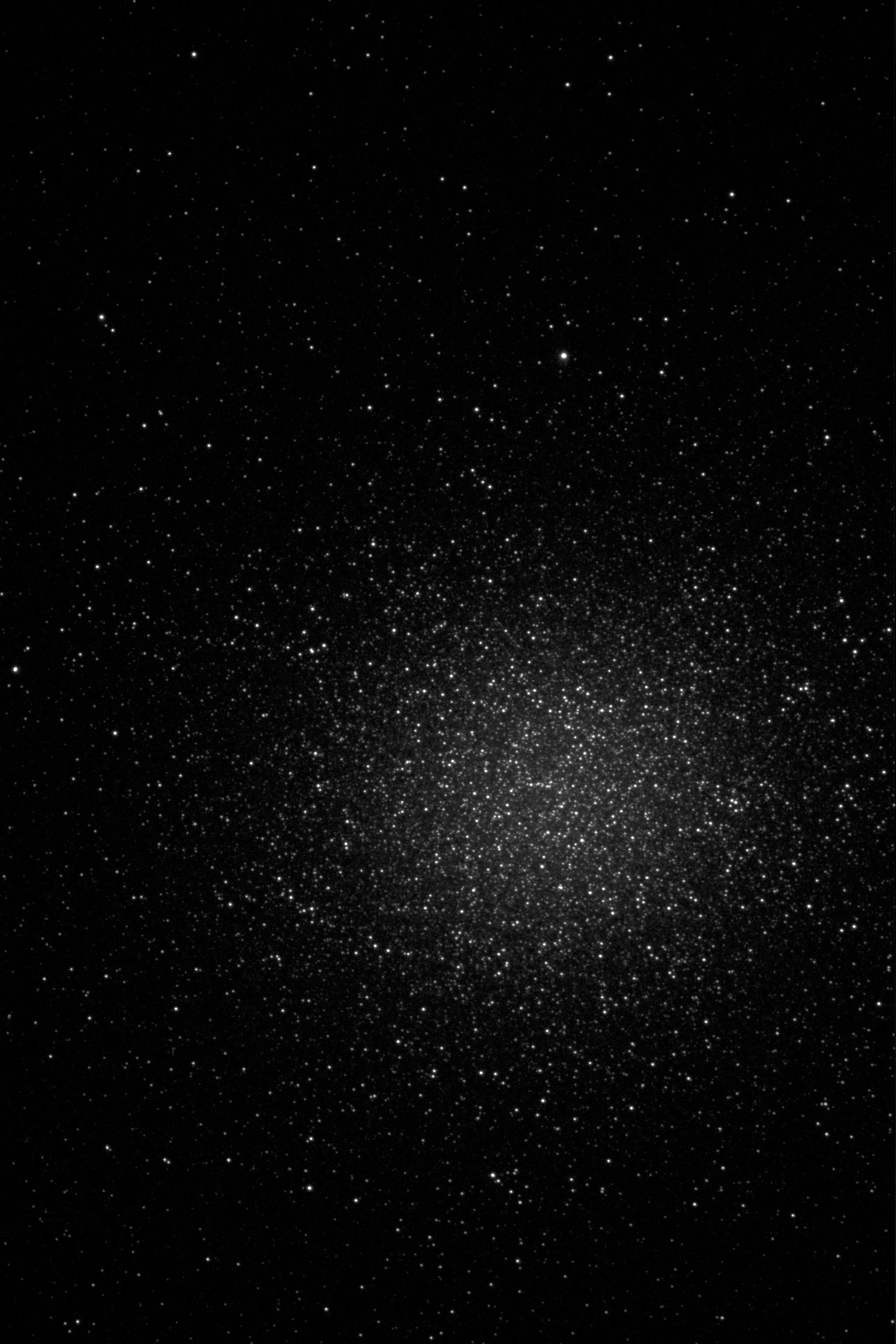
The globular star cluster Omega Centauri in a single 10-second R-band exposure on May 20, 2007, at Mt. Kent with the CDK20, an STL6303 CCD camera. North is up and west to the right in this image, which is scaled down 4x from the original size. It is displayed here with gamma=2.0 to stretch the visible dynamic range and reveal the fainter stars. A full resolution 2048x3072 (0.306x0.459 degree) version is available here. The brightest star in the image, north of center, is magnitude 8.4. It saturates the CCD's response at 10 seconds. Stars as faint as 18th magnitude are visible. Scan the full resolution image to see the quality of the corrected Dall Kirkham's performance to the edge of the field. While there was a nearly first quarter Moon when this image was recorded, the sky background is effectively zero in this short exposure.
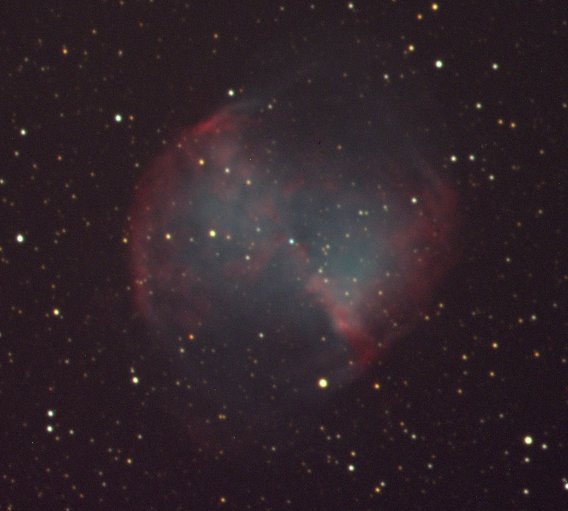
Three 300 second exposures of M27, the Dumbell Nebula, in R, G, and B color imaging filters were taken on August 8, 2006 at 03:12 UTC with the Moore Observatory CDK20 and an STL6303 CCD camera. The telescope was autoguided using SBIG software for these exposures. Each image was processed with Cinepaint to match its dynamic range to an 8-bit display, and the three images were combined in Gimp. Color was balanced so that stars appear to have colors corresponding to their spectra type. Notice that that white dwarf at the center of this planetary nebula is distinctly blue. While dark images were taken and subtracted to reduce noise, the images have not been flattened to compensate for the non-uniform response of the CCD. The bright sky in Louisville contributes somewhat to the background in this image. The original image was cropped and reduced in scale by 2x. This image covers 10.2x9.1 minutes of arc.