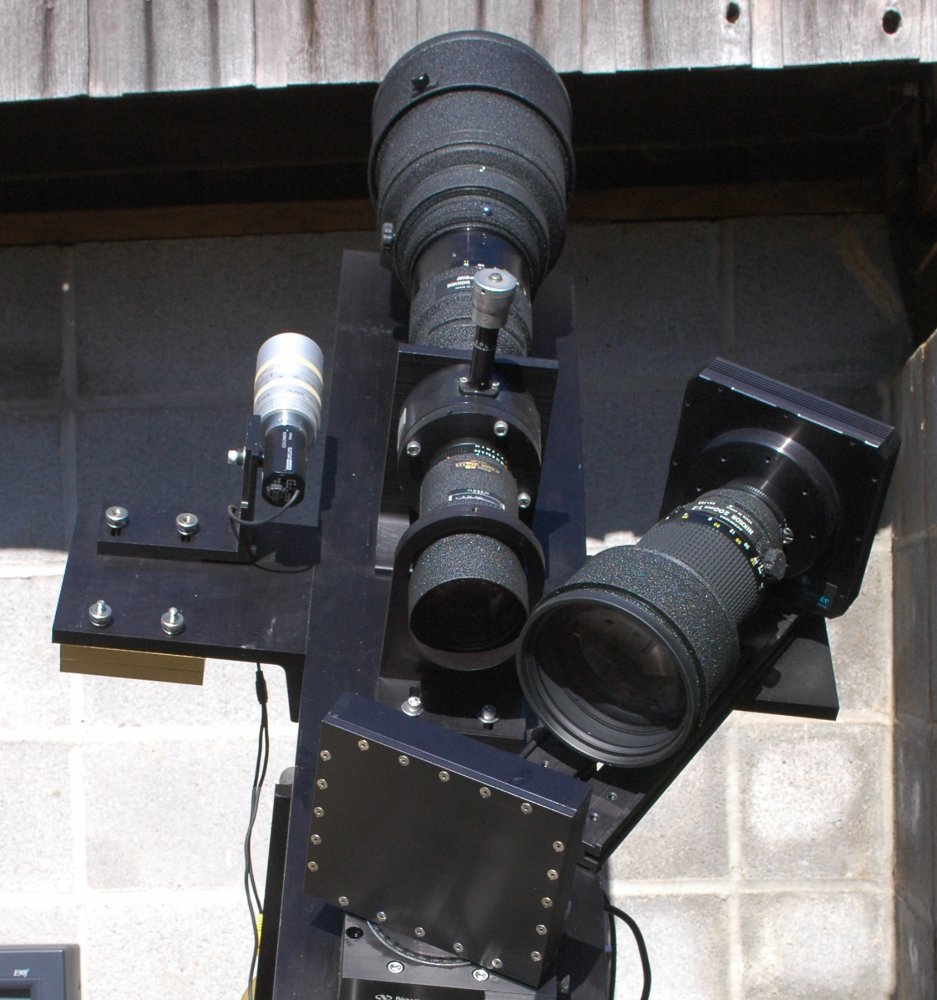
Click the image for a view without covers.
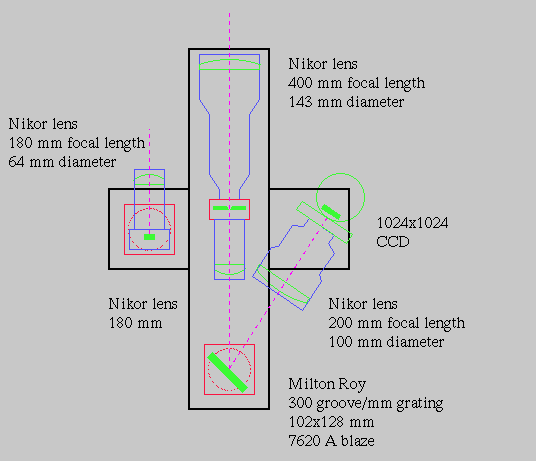
The Wide Field Spectral Imager (WISPI) was retired in 2018. Seen here in its last home in the Roll Roof Facility, it provided visible and near-infrared spectra of the sky across 4 degree fields. The instrument used a high speed optical system to form an image on the entrance slit of a matching stigmatic spectrometer, which disperses a spectrum of a 4 degree by 4 arsceond strip of the sky onto a charge coupled device detector. A computer controlled mounting automated the acquisition of 2-D rastered spectral images.
WISPI was used by Pamela Graham for studies of bright comets, including Hale-Bopp and Hyakutake that were her M.S. Dissertation project. A description of the instrument and her work appeared in "A Wide-Field Spectral Imager", Publications of the Astronomical Society of the Pacific, 112, 801-808 (2000). WISPI was renovated in 2010 to take advantage of improvements available in CCD detectors, drive systems, and software since its construction. Jeremy Huber used it afterward in his research on emission line ratios in extended star forming regions of the Milky Way which were included in his doctoral dissertation and in later publications.
Optical components from WISPI have been incorporated into a fiber-fed spectrograph to be used on our larger telescopes. The WISPI mount remains at the observatory for use in the Roll Roof and will hold up to 16-inch telescopes or other instruments.
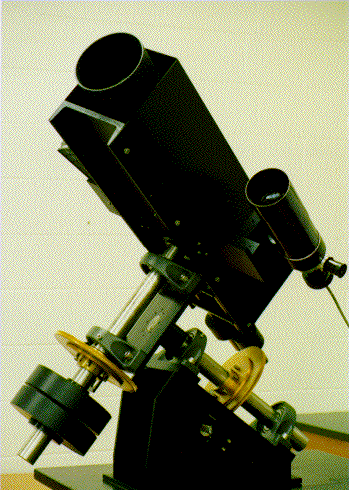
WISPI development was funded by a research grant from the Air Force Office of Scientific Research. It is shown here in the Applied Optical Physics Laboratory at the University of Lousville in 1994. Click here for a look at WISPI when it was in the main dome at Moore Observatory for observations of Comet Hale-Bopp with the original liquid-nitrogen-cooled CCD.
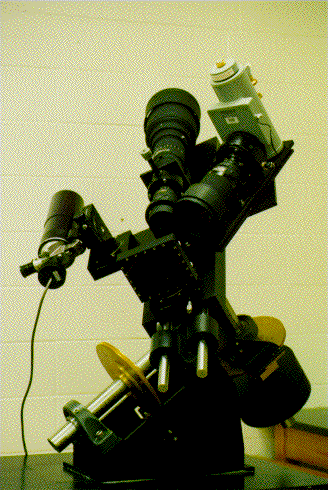
This 1995 photo of WISPI with its covers removed shows the internal optical system. Light from the sky enters the large 400mm lens at top center, is imaged on the slit, collimated by the smaller 180 mm lens, and diffracted by the grating at the bottom toward the 200mm lens and CCD camera on the right. This CCD was cooled with liquid nitrogen. A Questar tracking telescope, also since replaced, is on the left.
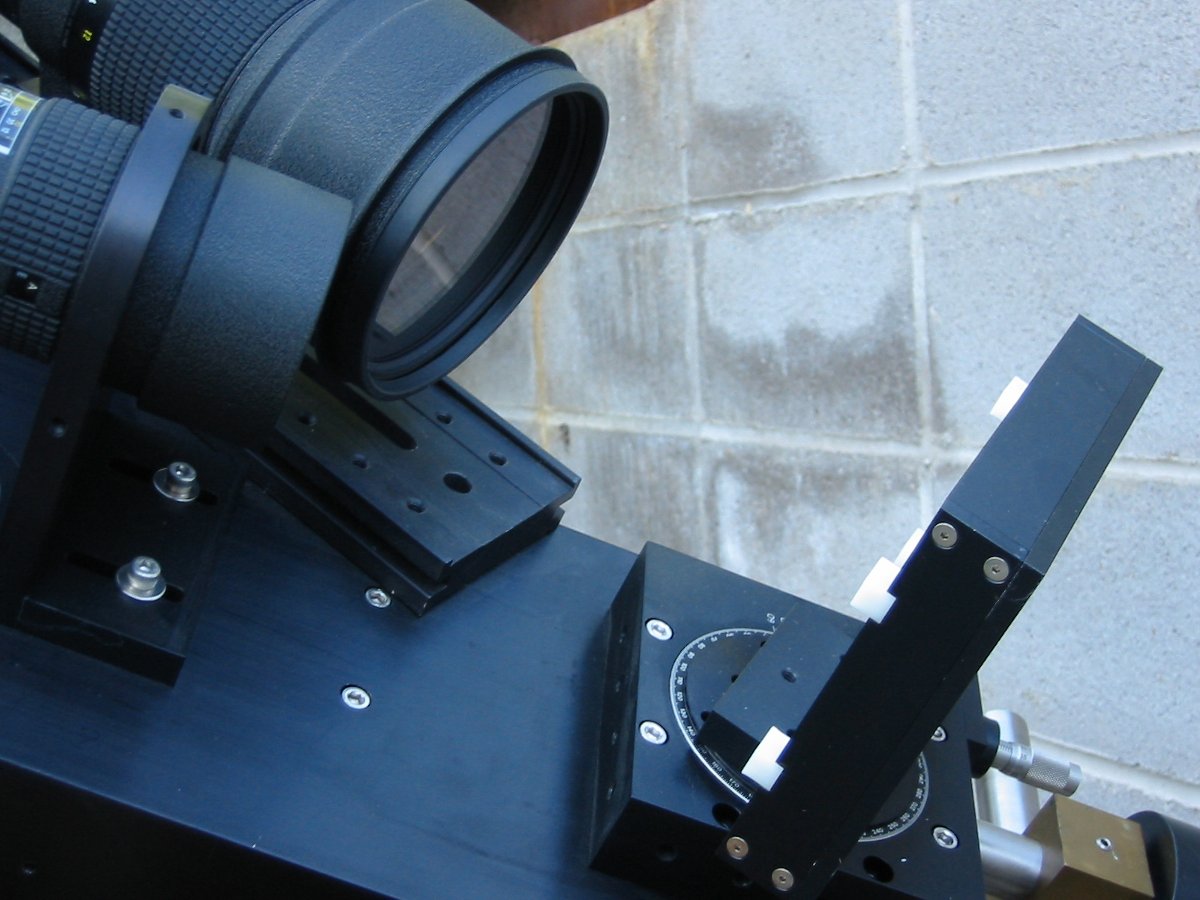
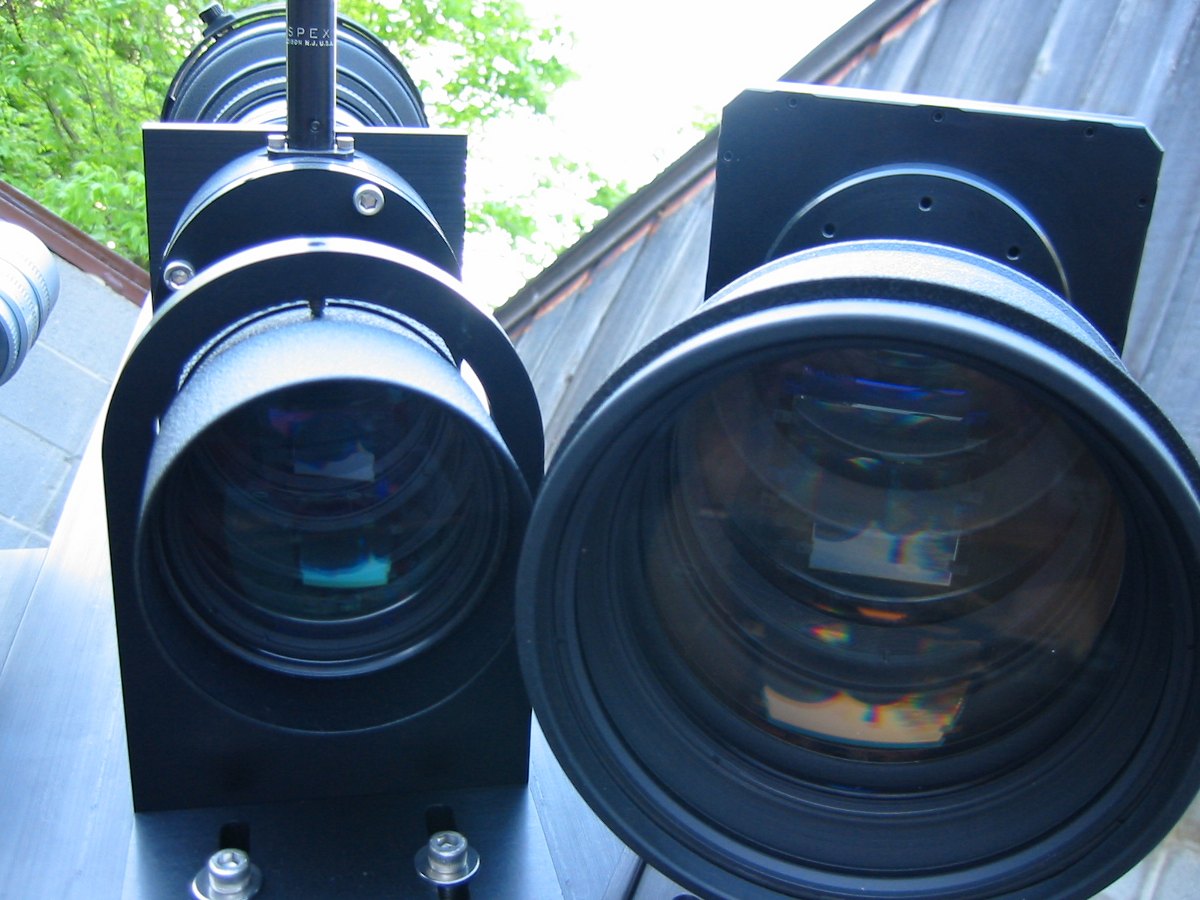
In its original design, WISPI required an operator on site to fill the dewar and
adjust the pointing based in part on visual centering in the guide telescope.
To enable remote operation, a sensitive video camera was added that feeds a live
image of the field to a network video server, the original liquid-nitrogen
cooled Tektronix detector was replaced with a Peltier-cooled Truesense/Kodak
detector in
an Apogee U6 camera of nearly the same size and sensitivity, the stepping motor
drive system was replaced with an encoded Galil DC servo motion controller, and
the original Forth-based software was replaced with a Python-based
system using XmCCD and XmTel under Linux.